- The Science Content Lab
- Posts
- Why Trust Is the Real Product in Healthcare Advertising
Why Trust Is the Real Product in Healthcare Advertising
In healthcare marketing, credibility matters more than persuasion.

Suchitha Champak
March 16, 2026
Welcome, reader!
Healthcare marketing operates under constraints that make traditional persuasion-based advertising insufficient. Patients are making high-stakes decisions under uncertainty, often with incomplete knowledge and emotional vulnerability. In this context, the central currency of healthcare communication is trust. Advertising in healthcare therefore functions less as persuasion and more as a system of trust signaling; that is, communicating competence, safety, credibility, and ethical responsibility. For healthcare providers, pharmaceutical companies, and digital health platforms alike, the effectiveness of marketing hinges on whether audiences perceive the organization as trustworthy enough to manage health outcomes that really matter.
Featured Insight: Trust Signals Outperform Persuasion in Healthcare Communication
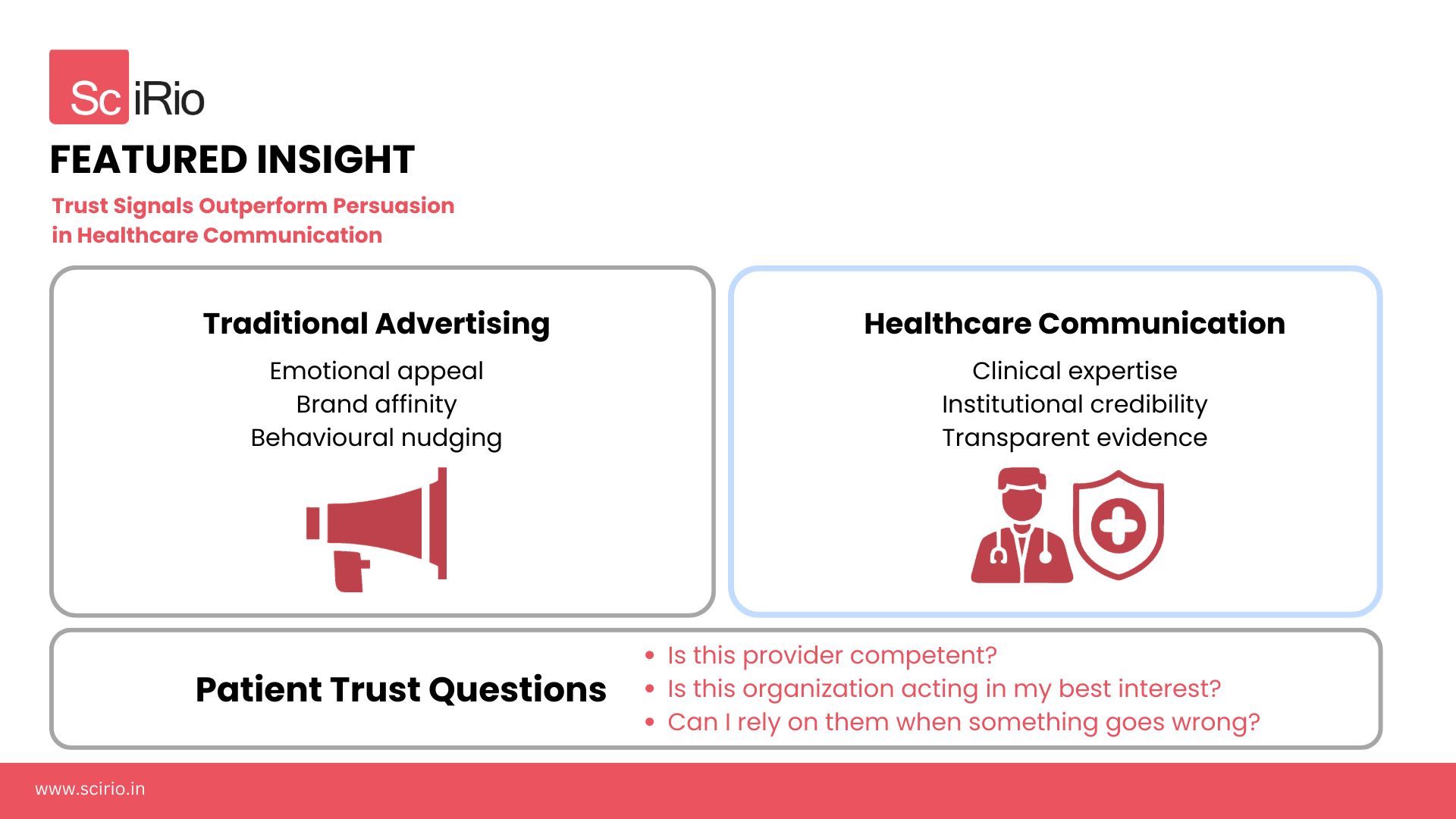
Traditional advertising theory emphasizes emotional appeal, brand affinity, and behavioral nudging. Healthcare diverges sharply here because information asymmetry is extreme: patients typically cannot independently verify treatment quality before making a decision. In economic terms, healthcare is a classic credence good. Its value is difficult to evaluate even after consumption.
Research in health communication and behavioral theory consistently shows that credibility cues such as professional authority, institutional reputation, and transparent evidence drive patient decision-making more strongly than promotional claims.
A review published in Healthcare highlights that trust in physicians and healthcare institutions strongly correlates with treatment adherence, preventive care uptake, and patient satisfaction (Source). When patients perceive healthcare messaging as promotional rather than informational, trust declines and engagement falls.
As a result, healthcare advertising relies on signals that implicitly answer three questions patients ask subconsciously:
Is this provider competent?
Is this organization acting in my best interest?
Can I rely on them when something goes wrong?
Instead of persuasive copy, the messaging architecture revolves around credibility indicators:
Medical expertise
Institutional legitimacy
Clinical outcomes
Compassion and care
In essence, the ad sells confidence in a relationship of care.
Innovation Showcase: Emerging Trust Mechanisms in Modern Healthcare Marketing
Several new approaches are reshaping how healthcare organizations operationalize trust signals.
1. Physician-Led Communication
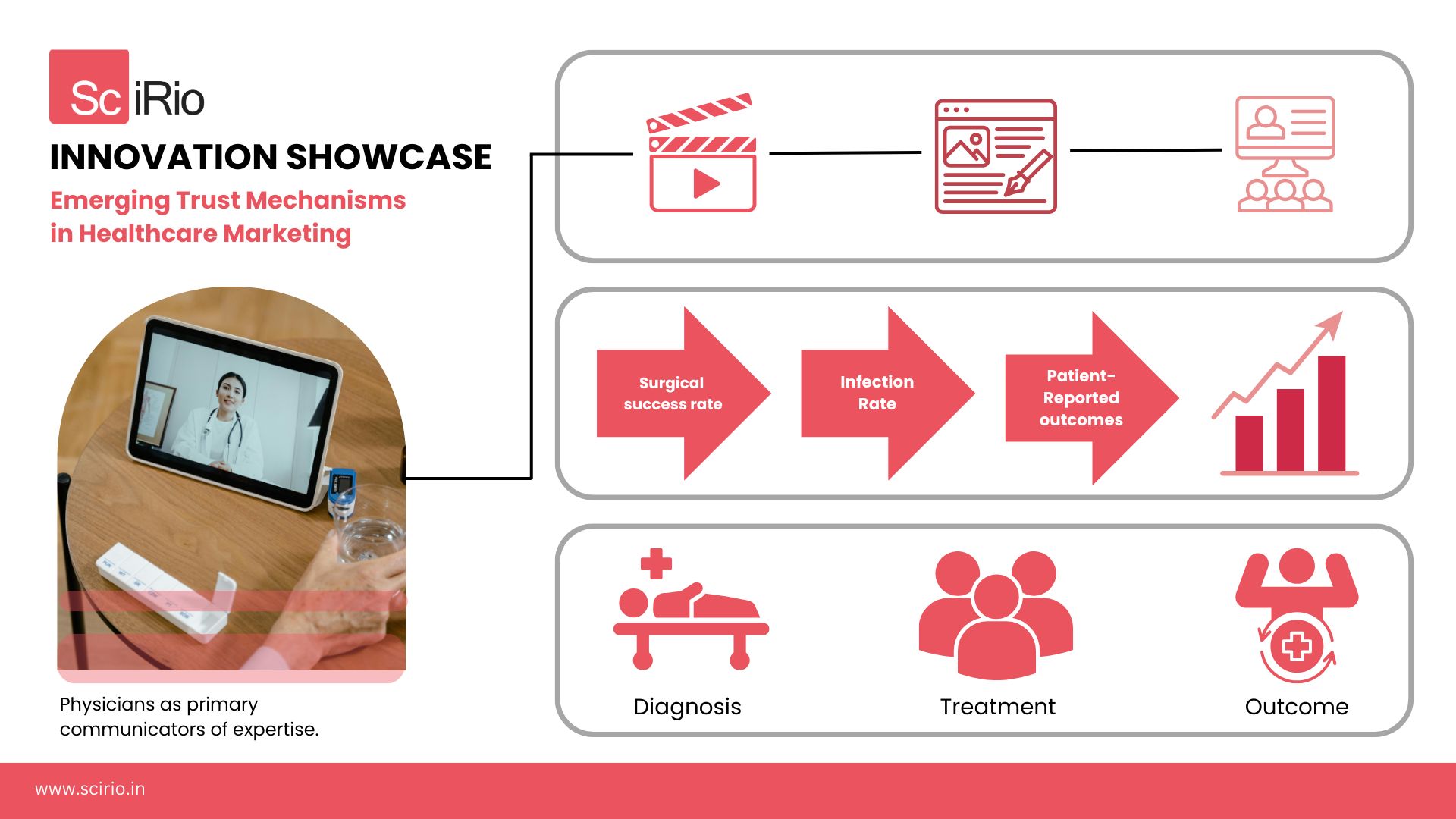
Hospitals increasingly foreground physicians as the primary communicators in marketing campaigns (Healthrr). Instead of anonymous branding, ads feature specialists explaining procedures, research expertise, or patient care philosophies.
This aligns with studies showing that physician credibility strongly influences patient decision-making. In a survey by Ipsos, physicians ranked among the most trusted professions in the United States (Ipsos).
Healthcare organizations now use physician visibility as a trust anchor across channels:
Video explainers
Clinical blog posts
LinkedIn thought leadership
Webinar-based patient education
2. Outcomes Transparency
Leading health systems are publishing measurable clinical outcomes, such as:
surgical success rates
infection rates
survival statistics
patient-reported outcomes
Institutions like the Cleveland Clinic regularly release outcomes data as part of public-facing communications. These metrics act as powerful trust signals because they shift messaging from promises to verifiable performance (Cleveland Clinic).
3. Patient Experience Storytelling
Patient testimonials remain a central narrative device but are increasingly framed as care journeys rather than marketing endorsements.
High-trust campaigns highlight:
patient autonomy
recovery processes
multidisciplinary care teams
However, strict regulatory frameworks shape how testimonials can be used, especially in pharmaceutical and medical device advertising.
Practical Tools: Frameworks for Designing Trust-Based Healthcare Campaigns
Healthcare marketers are beginning to treat trust as a measurable design principle rather than an abstract brand attribute.
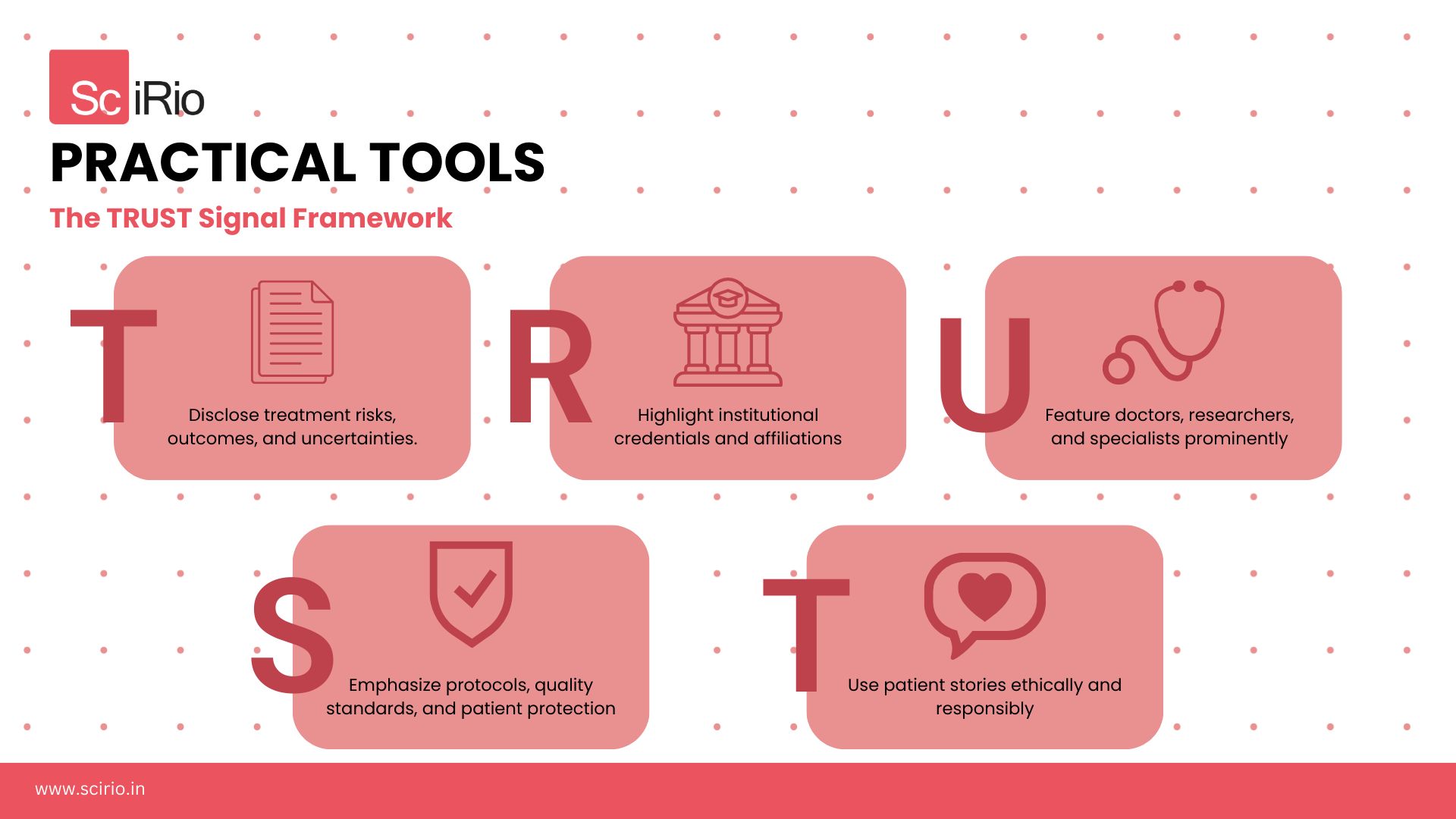
1. The TRUST Signal Framework
A practical model for healthcare messaging:
T - Transparency
Disclose treatment risks, outcomes, and uncertainties.
R - Reputation
Highlight institutional credentials and affiliations.
U - Expertise
Feature doctors, researchers, and specialists prominently.
S - Safety
Emphasize protocols, quality standards, and patient protections.
T - Testimonials
Use patient stories ethically and responsibly.
2. Evidence-Led Content Strategy
Healthcare audiences increasingly expect educational marketing, not promotional messaging.
Effective formats include:
condition explainers
procedure walkthroughs
research summaries
physician Q&A sessions
Content that improves health literacy doubles as a trust-building mechanism.
3. Third-Party Validation
External endorsements are powerful credibility amplifiers:
clinical trial publications
accreditation bodies
rankings and awards
peer-reviewed research
For example, references to accreditation by organizations such as The Joint Commission function as institutional trust markers (TJC).
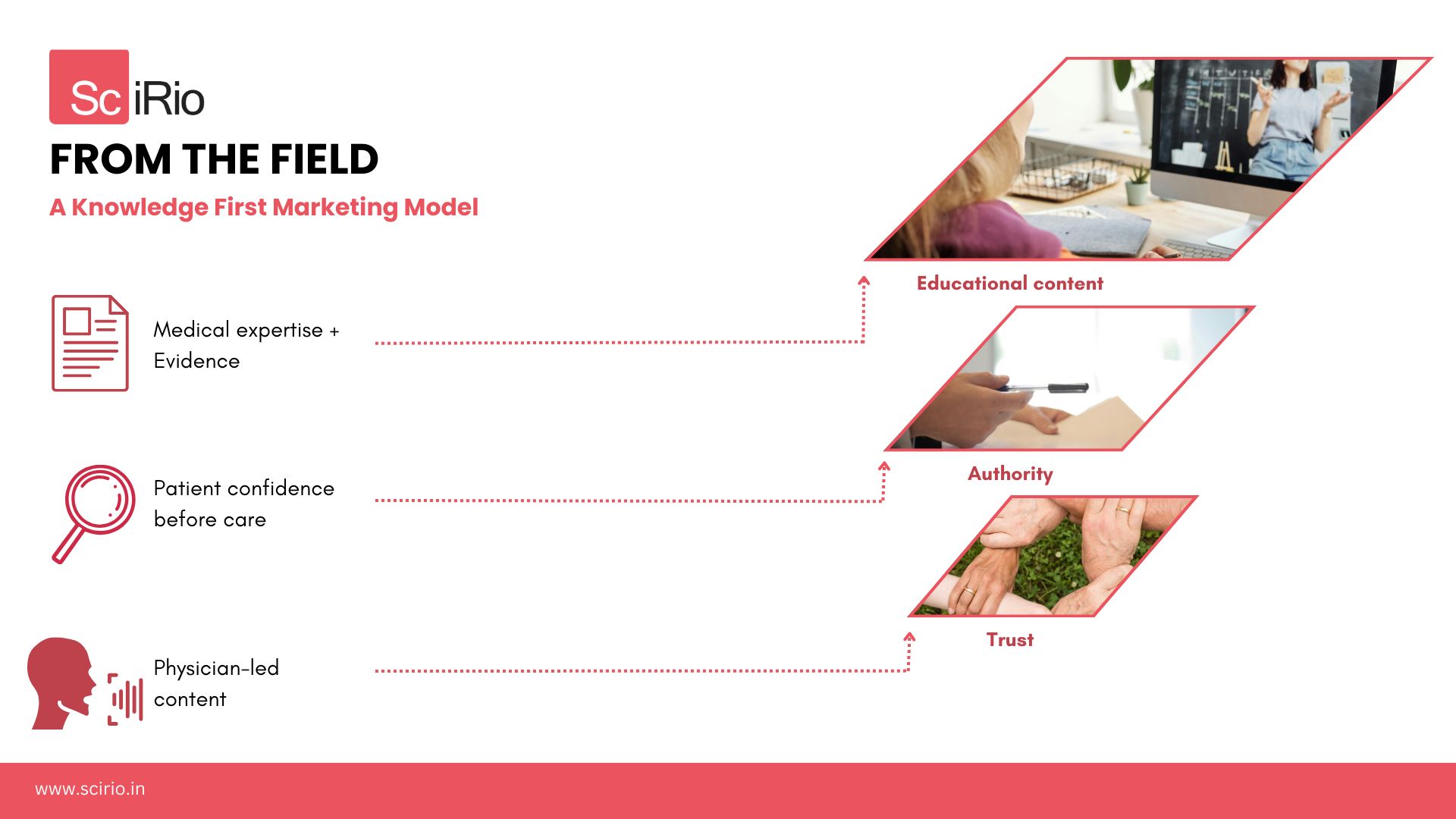
From the Field: Case Reflection: Mayo Clinic’s Knowledge-First Marketing Model
One of the most influential healthcare marketing approaches comes from Mayo Clinic, whose strategy centers on education as brand building.
The Mayo Clinic News Network publishes:
physician-authored articles
research updates
patient education resources
Rather than traditional advertising, the institution prioritizes information leadership. This approach positions Mayo as a trusted authority long before patients need care.
As a result, trust accrues through reputation and expertise, reducing reliance on overt advertising.
Healthcare marketing scholars often cite this model as an example of content-driven trust formation.
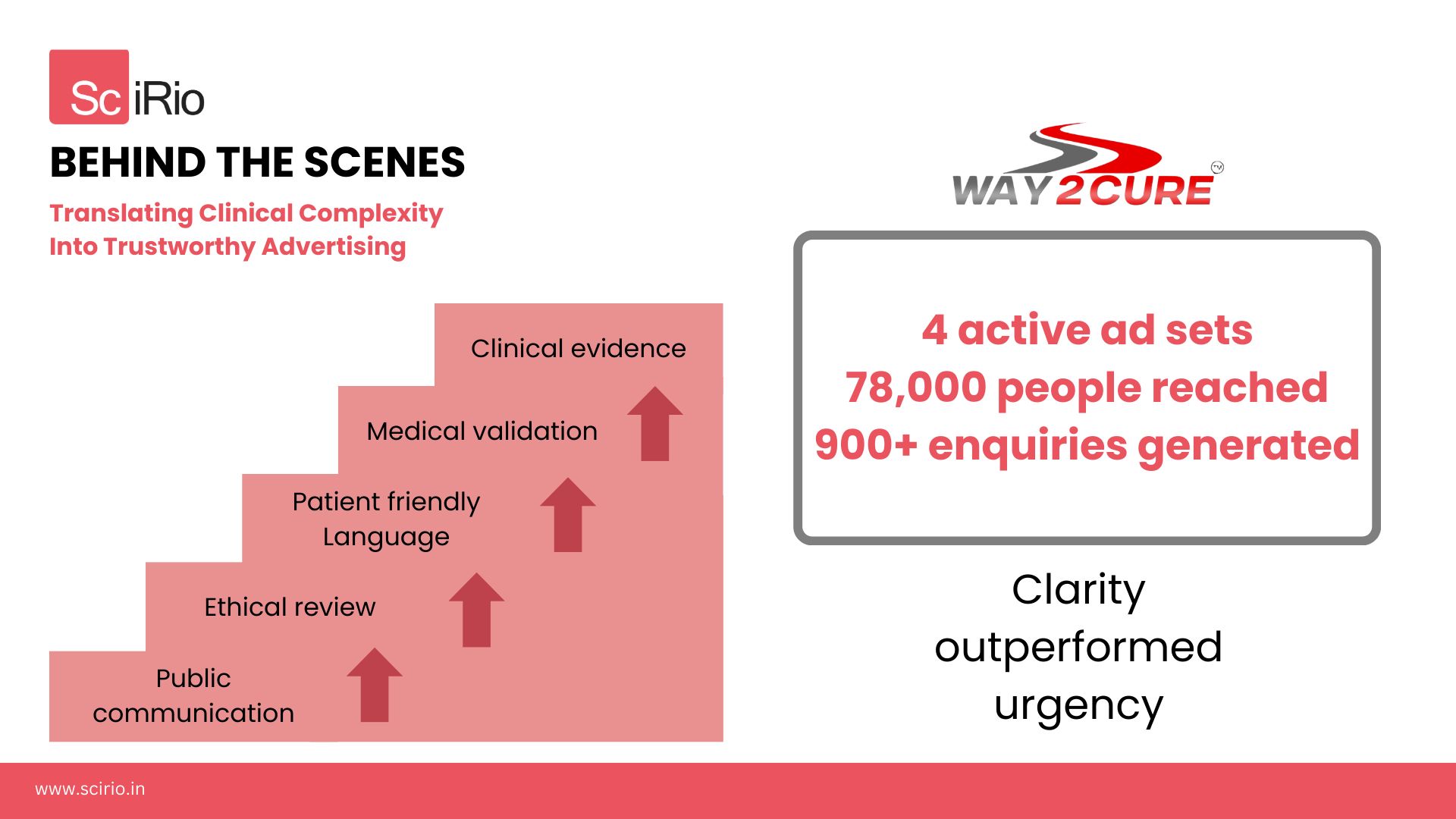
Behind the Scenes: When Healthcare Ads Emphasize Care, Safety, and Expertise
Translating clinical complexity into patient-facing advertising requires more than creative direction. It requires scientific literacy at the copy level.
SciRio’s recent work with Way2Cure reflects this clearly. Way2Cure provides home healthcare services, connecting families with trained caregivers and medical support for patients at home. SciRio has been developing the brand’s digital advertising, translating these services into clear, accurate messages that families can quickly understand and trust.
Every claim had to be grounded in evidence. Every benefit statement needed accuracy without oversimplification. Even the call to action had to balance urgency with the calm tone patients respond to when making healthcare decisions.
The February campaign quietly demonstrated what this approach can achieve. Four active ad sets reached more than seventy-eight thousand people and generated over nine hundred enquiries. Interestingly, the best performing ad did not rely on urgency or dramatic messaging. It led with clarity.
For research-intensive healthcare brands, this is often where science communication makes the difference. Accuracy does not limit good advertising. It is what allows it to work.
Community Corner: Emerging Discussions in Healthcare Marketing Ethics
Several ongoing debates are shaping the future of healthcare advertising:
Transparency vs Marketing Advantage
How much outcomes data should hospitals disclose publicly?
Patient Testimonials and Consent
Ensuring stories do not exploit vulnerable patients.
AI-Generated Health Content
Determining how synthetic media affects credibility in healthcare communication.
Professional communities discussing these issues include:
the Society for Healthcare Strategy & Market Development (SHSMD)
Healthcare Marketing & Physician Strategies Summit (HMPS)
academic research in health communication journals
These forums increasingly treat trust not as branding but as an ethical infrastructure for healthcare systems.
Final Word: Trust Is the Product Behind the Service
In most industries, marketing works by persuading customers to prefer one product over another. Healthcare is different. Patients are not simply choosing a consumer good. They are entrusting their wellbeing to an institution.
Because of this, healthcare advertising operates on a different strategic foundation: trust creation.
Doctor credibility, transparency about outcomes, patient narratives, and educational content all function as signals that reduce uncertainty in moments when stakes are high.
The most effective healthcare marketing does not try to persuade patients that a healthcare service is the best. It shows them why that service can be trusted when it matters most.
And in healthcare, trust is not just a marketing outcome. It is the foundation of care itself.
Missed the last edition? Read it here.