- The Science Content Lab
- Posts
- Structure Without Slowness: What Peer Review Teaches Us About Marketing Review Cycles
Structure Without Slowness: What Peer Review Teaches Us About Marketing Review Cycles
Codifying roles, criteria, and decision rights without killing velocity

Suchitha Champak
February 16, 2026

Welcome, reader!

In Conversation with Dr. Karishma Kaushik: Stories from the Frontlines of Indian Science
What does it really take to reinvent yourself in science?
This National Science Day (February 28th), join us in an intimate book chat with Dr. Karishma Kaushik in a candid, thoughtful conversation about science, identity, and the lived realities of Indian academia.
In partnership with Labhopping, we bring together a community of curious minds for an honest dialogue on navigating the scientific industry in India.
Her book, The Real Deal, traces the journey of a mid-career doctor who pivoted into science, while also unpacking the structural realities of the Indian research ecosystem.
Dr. Kaushik will explore key excerpts, discuss career transitions in STEM, confront imposter syndrome and gender bias, challenge persistent scientist stereotypes, and reflect on the vital role of mentors, allies, and scientific rigor.
Expect honest stories from someone who has worked across multiple levels of the Indian science landscape, and practical insights for students, early-career researchers, and mid-career professionals navigating their own paths.
If you’ve ever questioned your place in STEM, considered a career pivot, or wondered what it truly takes to build a scientific life in India - this conversation is for you.
Date: February 28th, 2026
Time: 11am—12pm IST
Location: Zoom
Want to sign up? Reach out to us now!
In science, peer review came around as a governance mechanism. Not to slow down discovery, but rather to encourage accountability.
In marketing, review cycles serve a similar function. They safeguard brand integrity, regulatory compliance, strategic alignment, and commercial performance. In high-performing organizations, these systems are already sophisticated.
But unlike academic publishing where review architecture is codified, marketing review structures can sometimes be more implicit. Roles, criteria, and decision rights definitely exist, but they may not always be pre-committed or documented.
What if marketing teams made their evaluation architecture as explicit as scientific peer review - not to add complexity, but to increase clarity?
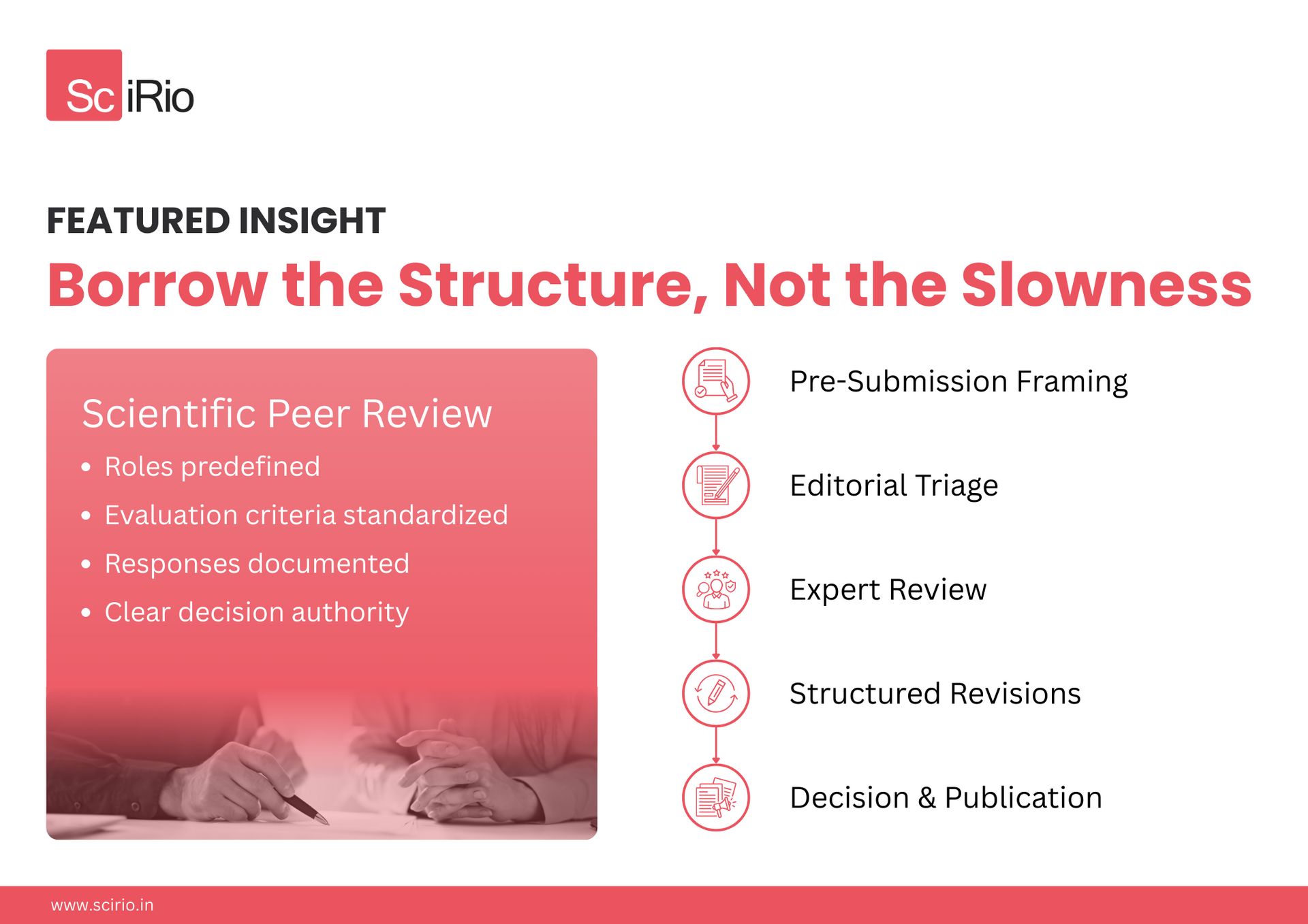
Featured Insight: Borrow the Structure, Not the Slowness
In academic publishing, the review process follows a pretty defined architecture:
Pre-submission framing
Editorial triage
Blind, domain-specific expert review
Structured revisions
Decision and publication
Contrast that with marketing review cycles:
Undefined success criteria
Expanding stakeholder lists
Feedback that mixes taste, risk, and strategy
Iterations without closure
Marketing review systems, especially in scaling organizations, might contain analogous elements; that is, campaign briefs, stakeholder sign-offs, legal review, and analytics validation.
The difference is not intelligence or rigor, but is explicitness.
In scientific publishing:
Roles are predefined
Evaluation criteria are standardized
Responses are documented point-by-point
Decision authority is clearer
In marketing environments, these elements may exist, but could be informal or negotiable.
The opportunity is not to “scientize” marketing but to codify what already works in high-performing teams. Defined roles, pre-committed criteria, and accountable decision logging.

Innovation Showcase: Applying Peer Review Mechanics to Marketing
Rather than importing academic protocols, marketing teams can selectively adopt certain structural mechanics that improve signal-to-noise ratio in review cycles.
Three governance principles translate well:
In academic review, experts evaluate within declared domains.
Marketing parallel:
Brand voice → Brand authority
Regulatory claims → Legal
Data accuracy → Analytics
Strategic alignment → Campaign owner
Clear domains can help reduce redundant commentary and protect decision-making speed.
2. Pre-Registered Evaluation Criteria
Scientific manuscripts are assessed against predefined questions: is the method sound? Are claims supported? Is the contribution novel?
Marketing teams can similarly pre-register evaluation prompts:
Does this asset directly advance objective X?
Are claims supported by evidence or data?
Does this align with person Y’s decision?
When criteria are defined before creative development begins, feedback becomes evaluative rather than exploratory.
3. Documented Response Matrices
In peer review, authors respond point-by-point to each critique.
In marketing, documenting comment disposition (Accepted / Clarified / Rejected with rationale) creates:
Closure
Institutional memory
Reduced feedback resurfacing
This practice means governance is strengthened without slowing down creative iteration.

Practical Tools
Here are some practical tools - software and open resources - that mirror te core mechanics of scientific peer review: structured critique, version control, and accountable decision logging.
1. Notion
Best for: Pre-registration + structured review templates
Use Notion to create:
A “Campaign Pre-Registration” database
Standardized review forms (linked to each asset)
A response matrix table (comment → disposition → owner → timestamp)
Why it maps to peer review:
Centralized documentation
Persistent version history
Explicit criteria before creative work begins
Bonus: Many operators share free LinkedIn templates for “Marketing OS” dashboards built in Notion.
2. Airtable
Best for: Reviewer assignment & approval tracking
Airtable works well for:
Assigning domain-specific reviewers
Automating approval status changes
Tracking review round count
Flagging overdue responses
Peer review parallel:
Editor triage → automated routing rules.
Especially useful in regulated sectors where audit trails matter.
3. Asana or Monday.com
Best for: Time-boxed review cycles
Configure:
Fixed review windows (48–72 hours)
“Silence = approval” automation
Locked reviewer lists per stage
Maximum two revision stages before escalation
Why this works:
Agile-style sprint constraints reduce revision creep and stakeholder drift.
Research alignment:
Time-bounded work improves throughput and reduces cognitive drag in matrix teams.
4. Google Docs (Suggestion Mode + Comment Resolution Log)
Best for: Structured critique discipline
Implement a rule:
Every comment must:
Reference objective
Propose specific change
Be resolved (accept / reject / clarify) before next round
Peer review equivalent:
Point-by-point author rebuttal letters.
Pro tip:
Export resolved comment logs to create institutional learning archives.
5. Open Science Framework (OSF)
Managed by Center for Open Science
Best for: Conceptual inspiration on pre-registration systems
Even if you don’t use it directly, OSF demonstrates:
Transparent documentation
Version-controlled project workflows
Public accountability structures
Studying how research projects are structured here can inspire better marketing governance systems.
6. Editorial Workflow Inspiration from
Many journals publish detailed explanations of their review workflows.
Use these publicly documented models to:
Design internal triage stages
Define acceptance criteria
Create escalation protocols
This is particularly useful for B2B, health, fintech, and climate marketing teams where claims must be defensible.
Bonus: Lightweight Tools for Smaller Teams
If your team is under 10 people:
The principle matters more than the platform.
Selection Guidance
Choose based on complexity:
Team Size | Recommended Stack |
|---|---|
3–7 people | Google Docs + Structured Template |
8–25 people | Notion or Airtable + Time-box rules |
25+ | Asana/Monday + Formal Review Matrix + Automated Escalation |

From the Field: When Process Discipline Accelerates Creativity
In both scientific research and performance marketing, credibility compounds over time.
Research institutions formalized peer review not because scientists’ creativity needed to be constrained, but because high-stakes claims required defensible scrutiny.
Similarly, marketing teams operating in regulated sectors like health, fintech, climate, or education increasingly formalize review systems to balance speed with defensibility.
The pattern is consistent:
When decision rights are explicit, iterations can accelerate.
When evaluation criteria are stable, revision cycles shrink.
When comment resolution is documented, institutional friction decreases.
A balance between constraint in approach and creativity in execution means reduced ambiguity.

Behind the Scenes: The Comment Matrix That Reduced Revision Cycles
In one of our content creation projects for a health client, an early draft returned with 27 comments from three stakeholders. The feedback ranged from strategic positioning to data validation to tonal preferences. Without structure, this would have triggered multiple revision loops.
Instead, we applied a review matrix.
Each comment was categorized into one of four domains: Strategic Alignment, Evidence Validation, Regulatory Risk, or Brand Voice. Every comment required a documented disposition: Accepted, Clarified, or Rejected (with rationale). Reviewer roles were pre-defined, and feedback windows were time-boxed to 48 hours.
Two structural rules changed the trajectory:
Only domain owners could approve within their scope.
No new stakeholders could enter after Round 1.
The result: revisions were reduced from a typical three rounds to two. Approval time decreased by nearly a week. More importantly, repeated feedback did not resurface in later stages.
Structure did not slow creativity. It protected it.
Community Corner
How does your marketing team handle review cycles, and how do you avoid slumps?
Join the conversation on SciRio’s LinkedIn.
Missed our last edition? Read it here.
Final Word
Marketing often treats review as a necessary friction. Science treats review as a credibility engine. This distinction is important. Peer review was never designed to slow innovation, but rather to protect it from collapse under weak assumptions.
If marketing teams adopt the structural intelligence of scientific review, they can gain:
Faster decisions
Fewer revisions
Higher trust
Stronger claims
In science, publication is the goal. In marketing, launch is the goal. Both depend on disciplined scrutiny.
The question is not whether to review, but how to review intelligently.
SciRio’s Blog
What do whispering voices, tapping sounds, and Bob Ross have to do with black holes and climate change?
More than you think.
Over at SciRio’s blog, Pakhi Dixit explores how ASMR, which was once dismissed as internet oddity, is emerging as a powerful science communication tool. Backed by neuroscience and behavioural research, she unpacks how gentle delivery methods are reducing anxiety, increasing attention, and making complex topics more digestible.
Read the full piece here.