- The Science Content Lab
- Posts
- Open Science as Infrastructure
Open Science as Infrastructure
Why Open Science is Becoming Strategic

Suchitha Champak
May 18, 2026
Welcome, reader!
A Note From SciRio
This edition will be the final newsletter for a bit, for a period of reflection and restructuring.
Over the last 70 editions, our goal has been to build a publication that translates scientific and technological change into insights for science communicators.
We would love to know what you've thought of the newsletter so far and if you would like to see it come back. Drop us a word at [email protected]!
Thank you for reading, sharing, and contributing to the conversations we’ve built together. We’re deeply grateful to everyone who has been part of the SciRio community so far.
A Quick Recap
In our previous edition, AI in India’s Healthcare: What Are the Latest Updates, we examined how India’s healthcare ecosystem is moving from experimental AI adoption toward operational deployment across diagnostics, hospital workflows, and public health systems.
What’s Inside
A deep dive into one of the most important emerging developments shaping applied AI and scientific innovation.
New tools, workflows, and research-backed methods with real implementation potential.
Practical resources and frameworks that readers can directly apply in research, product, or operational settings.
Real-world examples and field insights showing how organisations are translating ideas into deployment.
Forward-looking analysis connecting current developments to larger scientific, technological, and strategic shifts.
Institutions adopting open practices, including shared datasets, transparent methods, preprints, and reproducible workflows are increasingly outperforming closed systems in collaboration speed and ecosystem participation. UNESCO’s 2021 Recommendation on Open Science explicitly frames openness as a mechanism for improving reproducibility, trust, and collective problem-solving capacity.
In this edition, we explore how open science is no longer just an academic ideal. It is becoming operational infrastructure for how modern research organisations attract talent, build trust, accelerate collaboration, and scale influence.
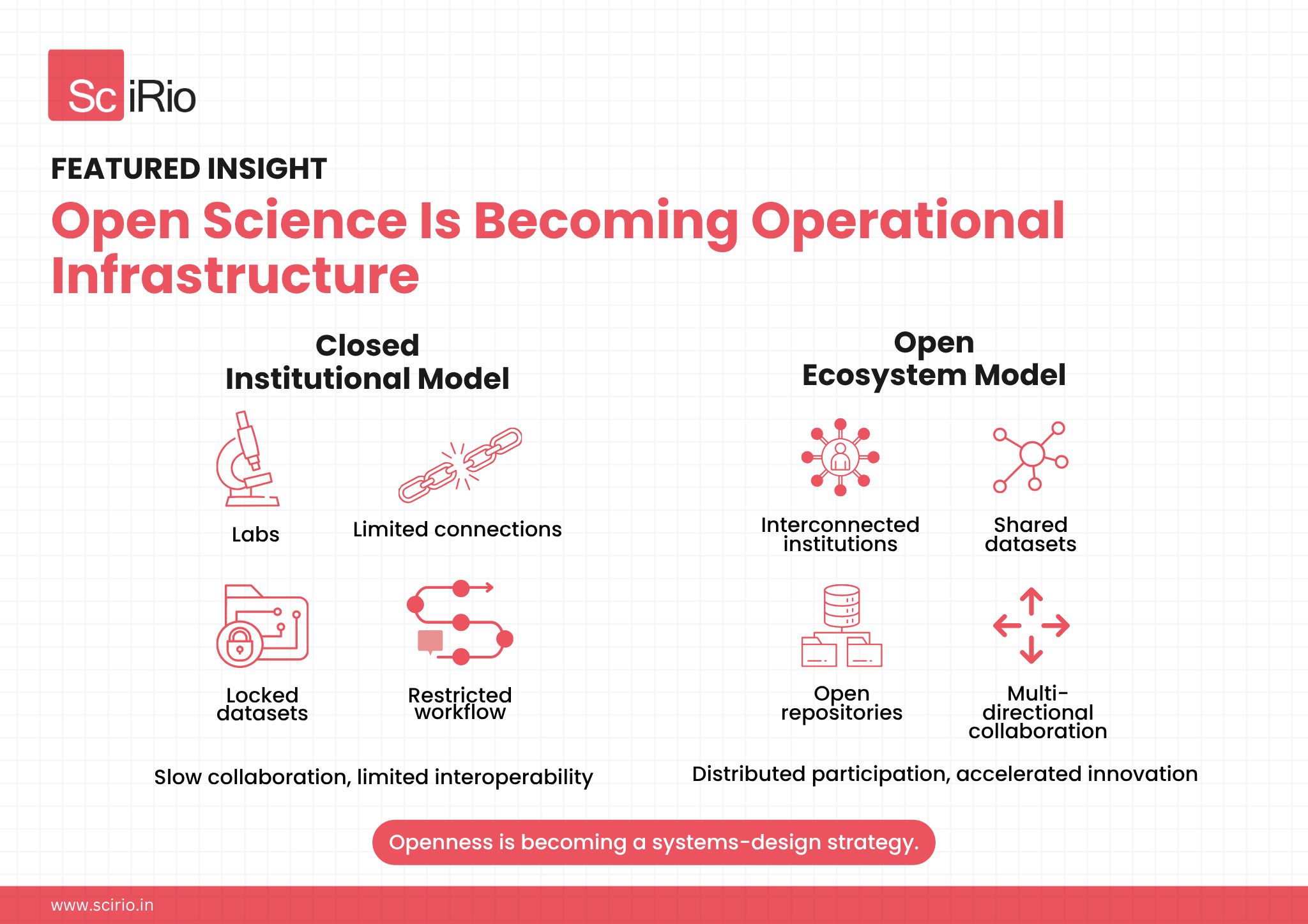
Featured Insight: Open Science is Becoming Operational Infrastructure
Open science is becoming the foundation on which how modern research systems coordinate, scale, and compete, and this is partly a response to the reproducibility crisis across multiple scientific fields. Large replication initiatives led by the Center for Open Science revealed major reliability gaps in published research which accelerates the demand for transparent methodologies and open validation systems.
But openness is now evolving beyond quality control.
Organisations publishing methods, code, and workflows publicly are also increasing recruitment visibility and collaboration velocity. Research on open-science adoption shows that transparent data and method sharing correlates with greater scientific recognition and broader participation networks. Also, studies show that open-science practices, including sharing data, materials, and code, positively influence public trust in scientific research.
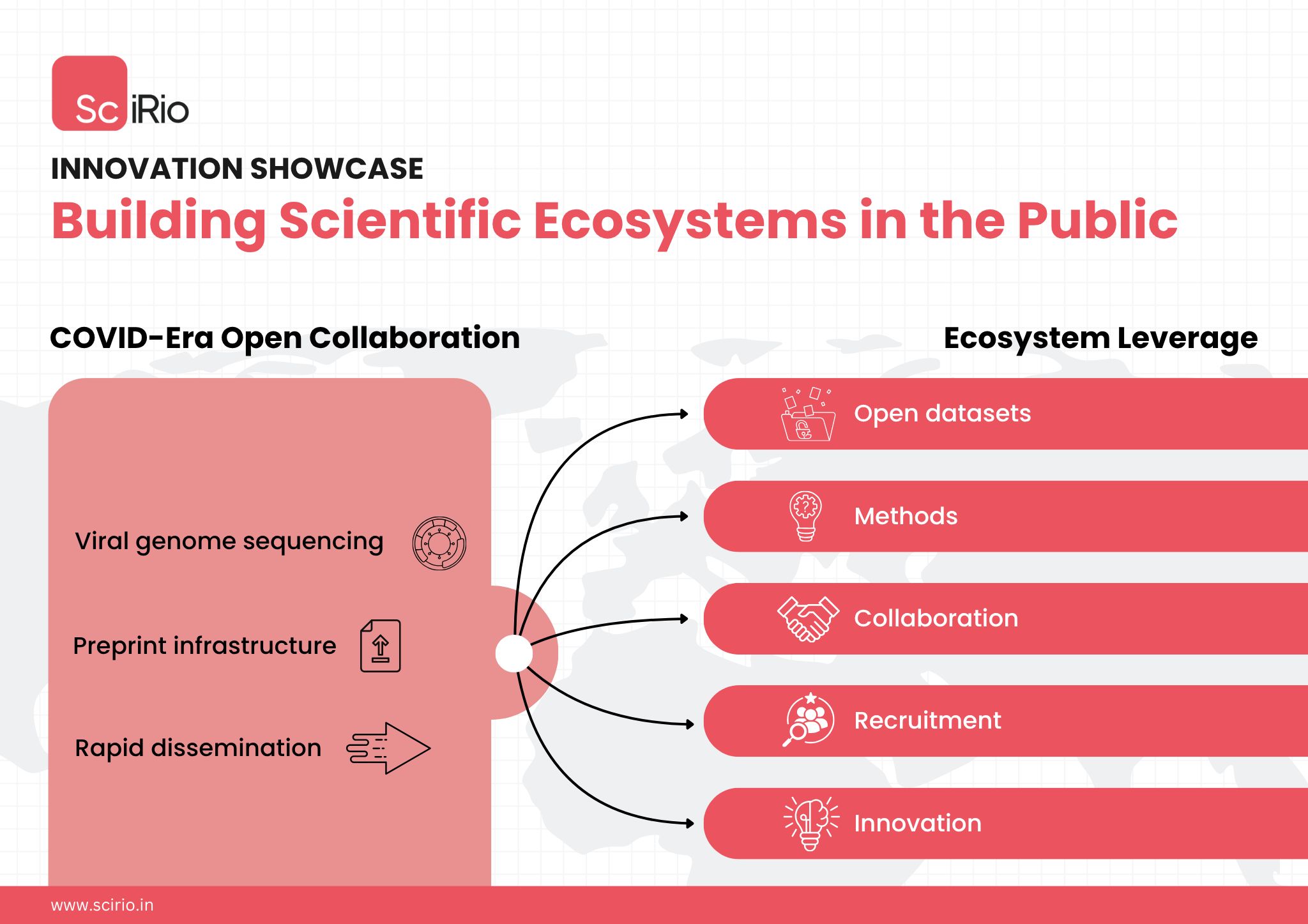
Innovation Showcase: Building Scientific Ecosystems in the Public
The strongest research organisations increasingly resemble platform ecosystems rather than isolated laboratories. Their influence scales not only through publications, but through architecture that allows for open participation: open datasets, transparent protocols, and public-facing technical communication.
This transformation is visible across multiple sectors.
In biotechnology, open preprint ecosystems accelerated COVID-era collaboration at unprecedented speed. Research groups publishing early sequence data, methods, and validation frameworks enabled downstream innovation far beyond the capacity of any single institution. What initially appeared to be scientific generosity became a demonstration of ecosystem leverage: openness dramatically increased global problem-solving throughput.
Open systems reduce coordination friction, accelerate iteration cycles, and increase the probability of cross-domain recombination, one of the strongest predictors of breakthrough innovation.
The institutional implications of this are difficult to ignore.
In recruitment, researchers and technical folk gravitate toward environments where methods, culture, and intellectual rigour are externally legible. Institutions that publish workflows, discuss failures transparently, and expose methodological thinking attract contributors who are aligned with collaborative execution rather than prestige opacity (Source).
Collaboration velocity also changes materially. The transaction costs typically associated with cross-institutional partnerships reduce with shared standards, accessible datasets, and transparent documentation. So, instead of rebuilding context repeatedly, organisations inherit interoperable knowledge systems (Source).
The organisations benefiting most from openness are not abandoning intellectual property or competitive positioning but selectively opening layers that increase ecosystem participation while protecting layers tied directly to commercialisation or regulatory defensibility.
The next competitive divide in science may therefore emerge not between public and private research, but between institutions capable of orchestrating collaborative ecosystems and those still operating through closed, institution-centric models.
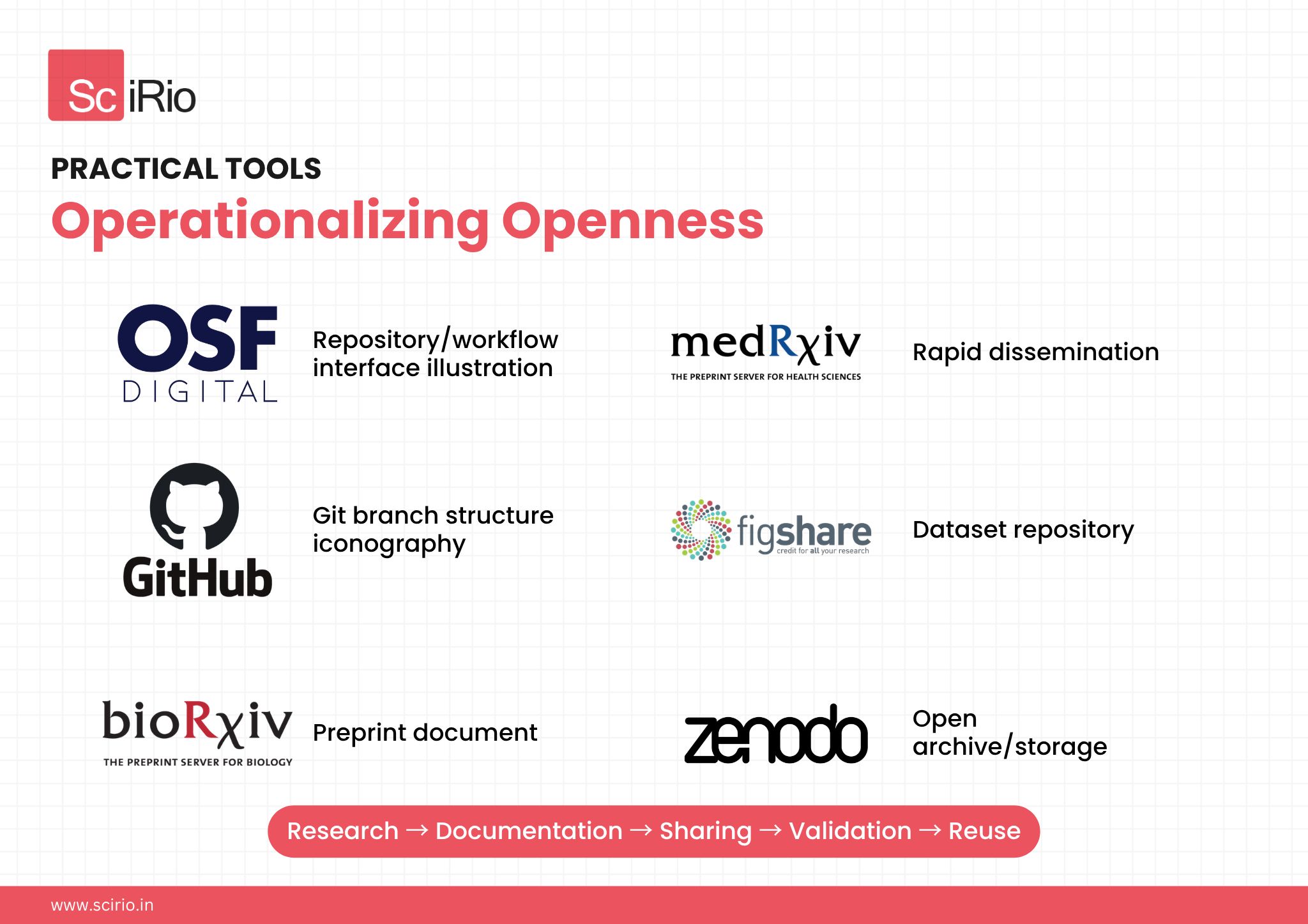
Practical Tools: Operationalising Openness
Organisations successfully adopting open-science models are investing in infrastructure that makes research easier to validate, reuse, and extend.
One major shift is the adoption of reproducible computational workflows using platforms such as OSF (Open Science Framework) and GitHub. Version-controlled repositories, containerised environments, and transparent documentation reduce onboarding friction and allow external collaborators to reproduce findings more efficiently.
Preprint ecosystems are also reshaping collaboration velocity. Platforms like bioRxiv and medRxiv accelerated knowledge dissemination during COVID-19 by allowing researchers to share findings before formal publication, significantly reducing communication lag across institutions.
Data-sharing infrastructure is becoming equally important. Open repositories such as Figshare and Zenodo are increasingly functioning as interoperability layers for distributed scientific collaboration.
Openness works best when embedded directly into research workflows rather than treated as a downstream publishing decision.
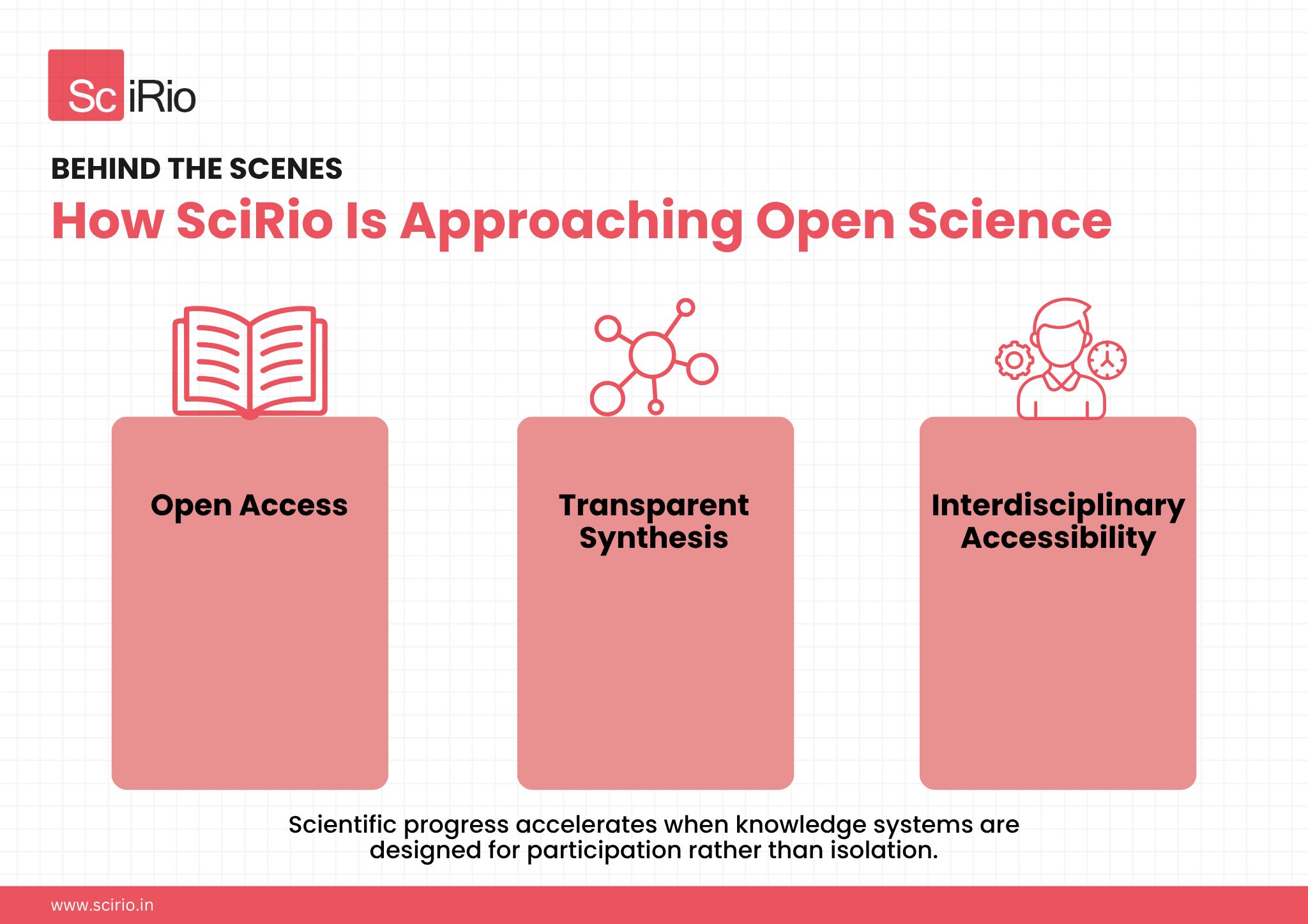
Behind the Scenes: How SciRio Is Approaching Open Science
At SciRio, we increasingly treat open science as infrastructure rather than ideology.
Our work prioritises open-access research, transparent synthesis, reproducible evidence trails, and interdisciplinary accessibility. We believe scientific progress accelerates when knowledge systems are designed for participation rather than isolation.
That perspective shapes how we approach research and translational communication: building openly, connecting disciplines, and reducing friction between discovery and implementation.
Community Corner: Building More Connected Scientific Systems
The questions surrounding openness are becoming increasingly operational:
How should institutions balance transparency with competitive advantage?
Which forms of openness accelerate translational adoption most effectively?
What infrastructure is required for large-scale interdisciplinary collaboration?
As research ecosystems become more networked, institutions designed for interoperability and collaborative participation will likely outperform those operating through isolated knowledge silos.
Final Word
Scientific advantage is increasingly determined by coordination capacity, not just information ownership.
Open science is becoming strategic because modern innovation depends on reproducibility, collaboration speed, public trust, and ecosystem participation. Organisations building transparent and interoperable systems are creating compounding advantages in recruitment, credibility, and translational impact.
Openness is no longer peripheral to scientific strategy.
It is becoming infrastructure for how science scales.
Missed the last edition? Read it here.
SciRio’s Blog
Last week on SciRio’s blog, Vaibhavi Kodnani explored one of the most structurally overlooked challenges in healthcare: the women’s health data gap. Despite women spending significantly more years in poor health compared to men, conditions such as endometriosis, PMS, menopause, and PMDD remain under-researched, underfunded, and routinely normalised. The result is delayed diagnosis, weak evidence infrastructure, and major gaps in public understanding.
The piece also examines the role of science communication in closing this gap, outlining seven principles for communicating women’s health more responsibly, from evidence sourcing and medical collaboration to accessibility and transparency around uncertainty. As healthcare systems increasingly recognise women’s health as a public-health priority, the quality of scientific communication surrounding these issues becomes equally important infrastructure.
Read the full insight: The Women’s Health Gap: Why Data Is Missing and How to Communicate the Science More Responsibly by Vaibhavi Kodnani.