- The Science Content Lab
- Posts
- Evidence, Ethics, and Excitement: The Three Es of Healthtech PR
Evidence, Ethics, and Excitement: The Three Es of Healthtech PR
Balancing accuracy, responsibility, and attention in digital health storytelling

Suchitha Champak
January 19, 2026

Welcome, reader!

Spotlight Partner – The Life of Science
As the conversation around evidence and ethics takes center stage in health communication, The Life of Science reminds us that curiosity is the foundation of credibility. Their Labhopping 2026 Desktop Calendar, SCIENCE: Fuzzy, Messy, Awesome!, celebrates the creative uncertainty that drives scientific discovery, a message that resonates with communicators seeking to balance precision and wonder.
Each page transforms a deceptively simple science question — Where does one species end and another begin? Why are humans so obsessed with measuring time? — into a visual and narrative exploration of how science has evolved. Illustrated by trans artist Ayan (ayanbythesea.com) and produced with over a dozen Indian researchers, the calendar models inclusive, open science storytelling at its best.
Proceeds support new multimedia reporting on TheLifeofScience.com, advancing equitable and evidence-based science communication across India. Supported by neuroscientist Abhilasha Joshi and the Peter and Patricia Gruber International Research Award, with SciRio as logistics and reselling partner.
Purchase and Support:
Bulk orders (5+): https://pages.razorpay.com/labhopping-desktop-calendar
Why the Best Healthtech Stories Don’t Choose Between Accuracy and Attention
In 2023, regulators in the U.S. and EU issued multiple warnings to digital health companies for overstated claims, particularly around AI diagnostics and remote monitoring. The U.S. Food and Drug Administration (FDA) has repeatedly emphasized that promotional claims must align with validated performance data, especially for software as a medical device (SaMD) (FDA guidance).
The message here is clear: excitement without evidence now carries regulatory and reputational risks.
But at the same time, healthtech companies face immense pressure to stand out in a crowded market. Doctors, investors, and patients are inundated with dashboards, algorithms, and promises of “AI-powered” transformation. Effective healthtech PR today must therefore operate in a narrow corridor where scientific integrity, ethical responsibility, and compelling storytelling coexist, rather than compete. An article by Digiteum touches upon the fact that exaggerated, overhyped health claims directly undermine patient trust and adoption, even when the underlying technology is sound (Digiteum).
This edition explores how communicators can balance the Three Es of Healthtech PR:
Evidence that withstands scrutiny
Ethics that protect patients and credibility
Excitement that captures attention without distortion
We’ll examine real-world examples, practical frameworks, and behind-the-scenes decisions shaping responsible yet high-impact healthtech communication.

Featured Insight: Evidence as the Narrative Backbone
Evidence is the plot of storytelling. Strong healthtech narratives are built around clearly articulated clinical questions, validated endpoints, and transparent limitations. A study in npg Digital Medicine emphasizes that communication aligned with peer-reviewed evidence improves clinician confidence and accelerates adoption of digital tools (npj Digital Medicine).
A practical example is how digital therapeutics companies increasingly cite primary endpoints directly from published trials in press materials, rather than summarizing outcomes in vague marketing language. This approach mirrors recommendations from the International Medical Device Regulators Forum, which calls for traceable evidence links in public-facing claims (IMDRF).
The key takeaway is that evidence should drive the story arc, and not be buried in footnotes.

Innovation Showcase: Ethical Storytelling in Digital Health
A notable example comes from Apple’s cardiovascular research communications. When publishing results from the Apple Heart Study, the company worked with academic partners to release findings through the New England Journal of Medicine, ensuring claims about atrial fibrillation detection were contextualized with limitations and false-positive rates (NEJM).
Rather than overselling diagnostic certainty, Apple’s PR aligned excitement with ethical responsibility by emphasizing risk communication and patient follow-up. This transparency became a credibility asset rather than a constraint.
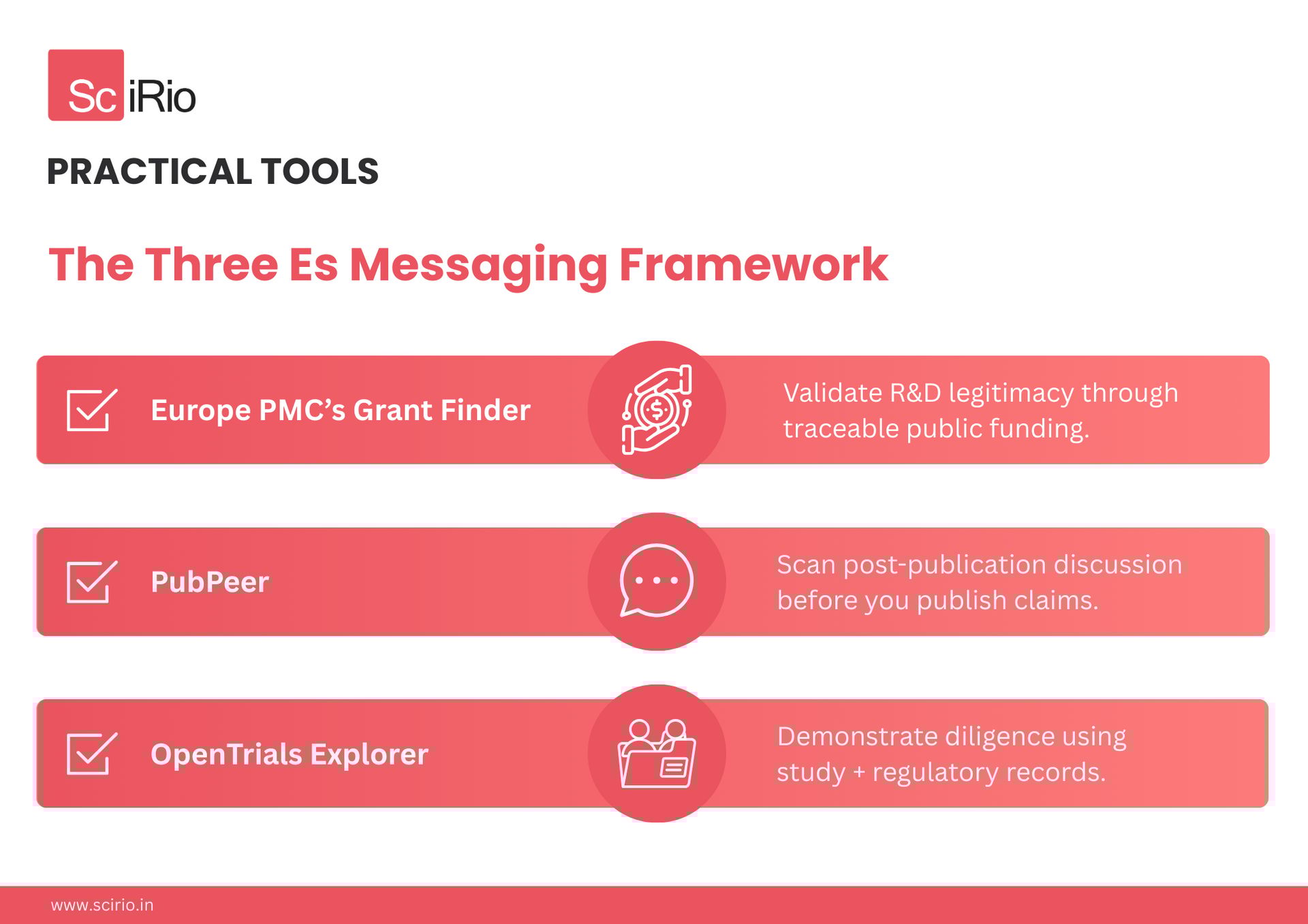
Practical Tools: The Three Es Messaging Framework
As evidence-driven storytelling becomes the new standard in healthtech communication, transparency is a competitive advantage. Teams that integrate open data tools early can build credibility before a single press release goes live.
Here are three freely accessible platforms helping communicators anchor their narratives in verifiable proof:
Europe PMC’s Grant Finder – helps locate and reference active public funding sources to validate R&D legitimacy (Europe PMC).
PubPeer – provides a quick check on post-publication discussions by researchers, which helps PR teams anticipate questions about reproducibility or controversy before release (PubPeer).
OpenTrials Explorer – collates regulatory and study data for early-stage startups aiming to demonstrate due diligence in disclosing evidence (OpenTrials).
From the Field: What Healthtech Communicators Are Learning
Experienced medtech communicators report that journalists and doctors now routinely ask for study links, preprints, and regulatory status before engaging. According to a qualitative analysis in Journal of Medical Internet Research, transparency in early-stage communication improves long-term brand trust, even when results are incremental (JMIR).
What this means is that there is a cultural change in how credibility is built. Media and clinical audiences now expect verifiable data and accessible summaries that talk about real progress. As a result, healthcare communication teams are learning to collaborate earlier with R&D and regulatory units, which ensures that each announcement or press note is backed by traceable and open-access proof.
The new frontier of healthtech PR, then, isn’t louder messaging, but evidence fluency: knowing how to translate complex validation into trustworthy, human-centered stories that withstand professional scrutiny and build confidence across audiences.

Behind the Scenes: Designing Excitement Without Overclaiming
High-performing healthtech campaigns increasingly use clear, evidence-led narratives instead of buzzwords, thus visualizing impact, context, and credibility side by side.
We recently began a partnership with Healthnovo, a digital health ecosystem bringing healthcare access to underserved communities. We applied this same principle to bridge the gap between innovation and public understanding by drafting impactful PR and founder LinkedIn posts.
Rather than spotlighting technology for its own sake, we framed their primary healthcare verticals as a solution to a pressing challenge: access to diagnostics. Each message emphasized how their devices and First Mile Clinics extend healthcare reach while maintaining accuracy and affordability, proving that responsible communication can make advanced technology feel human, local, and trustworthy.

Community Corner: How Do You Balance the Three E’s?
Where do you draw the line between excitement and overstatement in healthtech storytelling? Share your perspective with the SciRio community on LinkedIn:
Missed the last newsletter edition? Read it here.

Final Word: Credibility Is the Ultimate Growth Strategy
In healthtech PR, attention is easy to win and hard to keep. Evidence sustains trust, ethics protect patients, and excitement, when responsibly crafted, amplifies both. The future belongs to communicators who can hold all three without compromise.
SciRio’s Blog
Science communication has changed steadily from bustling museums to AI-powered platforms. Part 2 of the series on SciComm through the ages explores how formats old and new continue to shape public understanding. From the roots of Citizen Science and community radio to the rise of virtual reality learning and AI-driven research summaries, it traces how technology and tradition now coexist in communicating discovery.
Read the full story here.